As a PA (Personal Assistant), an EA (Executive Assistant) or secretary you may be asked to undertake an appraisal, this could be for junior members of staff. An Appraisal, Performance Review or Staff Review happens once a year. The appraisal gives the employee and the employer an opportunity to openly discuss the previous years working structure.
Some General Guidelines
Conducting an appraisal if you are a PA
Appraisals are on an individual employee’s job description. If you are conducting the appraisal you need to ensure that you are aware of the employee’s job description and not undertake a comparison with other employees. You also have to be aware that the appraisal is on their past performance and not on what you would like them to do. That is the value of job analysis and detailed job descriptions.
A rating system may form part of the appraisal process. The rating system could be a numerical, alphabetical system or a combination. All PAs or secretaries conducting an appraisal should be trained on the rating system used. A good rating could result in a pay rise or promotion. It is important that the rating system is robust, understood and utilised.
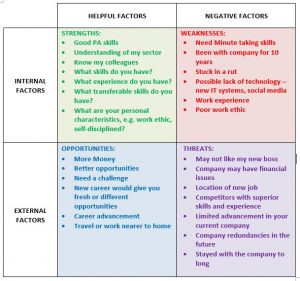
Whether you are starting a business, expand an existing business or looking for a new PA Job, a SWOT analysis could help you to make the right choices for your business or career. SWOT is an acronym to remind you of subject headings you should think of when making those decisions.
What comes to mind when you think about the skills that make exceptional PAs, secretaries, and administrators? Organisation? Efficiency? Multitasking? While these are all essential, there’s one skill that quietly underpins them all: listening.
Listening isn’t just about hearing words. It’s about understanding, connecting, and responding in a way that helps you do your job better and strengthens relationships with your colleagues. The ability to truly listen is a superpower, and like any superpower, it takes practice to master.
Why Listening Matters
We’re often the go-to person for information and problem-solving in our roles. Whether it’s capturing instructions, taking minutes in a meeting, or understanding a colleague’s needs, listening is the foundation of it all. But here’s the kicker: on average, most of us only retain 30-50% of what’s said in a conversation. Shocking, right? It’s no wonder that miscommunication happens so often. As PAs, secretaries, and administrators, this is where we need to step up. Developing strong listening skills helps us bridge that gap, ensuring nothing important slips through the cracks.
Sometimes, it’s not just what’s said, it’s what’s unsaid that matters. I learned this lesson during a conversation with a colleague who asked if I knew how to input invoices. At first, it seemed like a straightforward request. But when I asked if he needed help with data entry, it became clear that wasn’t the issue. The real problem? The VAT was in chaos, and he needed help sorting it out.
This experience taught me that listening isn’t just about words. It’s also about tone, body language, and context. These subtle cues often reveal the bigger picture, and as professionals, it’s our job to piece it together.
The Five Pillars of Exceptional Listening Skills
Ready to level up your listening game? Here are five essential aspects to focus on:
Pay Attention: Stay present. Look at your colleague directly and avoid distractions like checking your phone or glancing around. Pay attention not just to their words but also to their body language. Are they anxious? Excited? Nervous? These cues provide valuable insight. Show You’re Listening – A little encouragement goes a long way. Nod occasionally, make eye contact, and use verbal affirmations like “I see” or “Go on.” But don’t overdo it—no one likes a chorus of “uh-huh” after every sentence. Clarify and Confirm: Repeat what you’ve heard when receiving instructions. For example, “So, you’d like me to prioritise the client’s report and follow up on the invoices, correct?” This simple step prevents misunderstandings and reassures your colleague that you’re on the same page. Be Patient: This might be the most challenging skill to master. Resist the urge to interrupt or jump in with solutions. Let your colleague finish speaking before asking questions or offering ideas. Sometimes, just allowing them to articulate their thoughts leads to a clearer conversation. Respect Their Perspective – Listening isn’t just about understanding tasks. It’s also about building trust. Respect your colleague’s time, ideas, and opinions, even if you see things differently. Collaboration thrives on mutual respect, so approach every conversation with a team-focused mindset.
The Bigger Picture: Types of Listening Skills
Listening comes in many forms, and each plays a unique role in your professional toolkit.
Active Listening: Fully focusing on the speaker, engaging with their message, and responding thoughtfully. (Check out my recent blog post on active listening for more tips!)
Reflective Listening: Listening with empathy and reflecting back emotions or concerns to build understanding.
Passive Listening: Taking in information without immediate engagement, often useful in observational scenarios.
In the coming weeks, I’ll dive deeper into reflective and passive listening, exploring how these approaches can enhance your role as a PA, secretary, or administrator. Stay tuned!
Listening Skills: The Key to Your Professional Growth
Mastering listening skills isn’t just about doing your job well—it’s about excelling in your role and becoming an indispensable part of the team. When you listen effectively, you:
Build trust and rapport with colleagues.
To gain clarity and avoid misunderstandings.
Handle tasks more efficiently and confidently.
By honing this skill, you’ll meet and exceed expectations, paving the way for personal and professional growth.
What’s Next?
Listening is a journey, not a destination. Start by practising the five pillars above, and don’t forget to explore different listening styles to expand your skill set. Check out my article on Active Listening for actionable tips you can implement today. Keep an eye out for upcoming posts on Reflective Listening and Passive Listening, where we’ll explore how these approaches can make you an even stronger communicator. Are there any listening challenges you face in your role? Share your thoughts in the comments—I’d love to hear from you!
Have you heard of the term CPD? Do you know what it means and more importantly, do you know what it involves?
CPD stands for Continued Personal/Professional Development. In short, it means that you continue to study after you finish school, college or graduate from university. There are a number of professions that once you achieve a pass mark in the basic qualifications will be the start of a lifetime of study, for example, a solicitor, a doctor or a planner. What about your profession? Do you need to embark on CPD?
If your profession does not demand Continued Professional Development, have you made the decision to discontinue studying? To have a successful career, we advocate a continued approach to education/studies. Continued Professional Development is there to help you excel in your chosen field. CPD will also keep you abreast of the latest trends, legal changes and current business relationships which ultimately could give you an advantage over your colleagues.
Education never stops
Making a personal decision to continue your education/studies and improve your knowledge in your chosen field may become a prerequisite for your employment. An example of this is the IT Industry. Information Technology is changing all the time and good developers, support staff and programmers need to keep abreast of current technology, languages and innovations. If you decided to terminate your studies, this could have a detrimental effect on your career.
Once you have made the decision to continue with your education, what should you do? There are a number of organisations that can facilitate your education. The only decision you need to make will be, which route suits your personal circumstances:
Online training courses
Studies in a classroom setting – often given by trade bodies
Correspondence courses
Seminars and Open days
Trade Federations
Professional Magazines in a chosen field
What is CPD for your occupaation?
You could be in an occupation where CPD is not required. Nevertheless, this does not mean that further study is not for you. It could be advantageous for you to engage in a study course with a local college or night class in one of the hobbies you enjoy for example cooking or sewing. Furthermore, you could learn a new skill, for example, car maintenance.
Further, more studying has a number of wonderful side effects. You could meet new people, gain skills and more importantly keep your brain active. Indeed, the Alzheimer’s community have suggested that keeping your brain active could help prevent many mind degenerative disease.
All studying requires is your dedication to the course, that you will be receptive to new concepts, your time and the drive to become successful
Welcome to our online magazine from Julie and the team. If you have been on one of Julie’s training courses, you know she is passionate about PA, EAs and Secretaries being the best they can be. She also has very strong opinions about what a PA, EA and Secretary should and shouldn’t do. If you have a question, or would like to add an article, please get in touch. We would love to hear from you.